
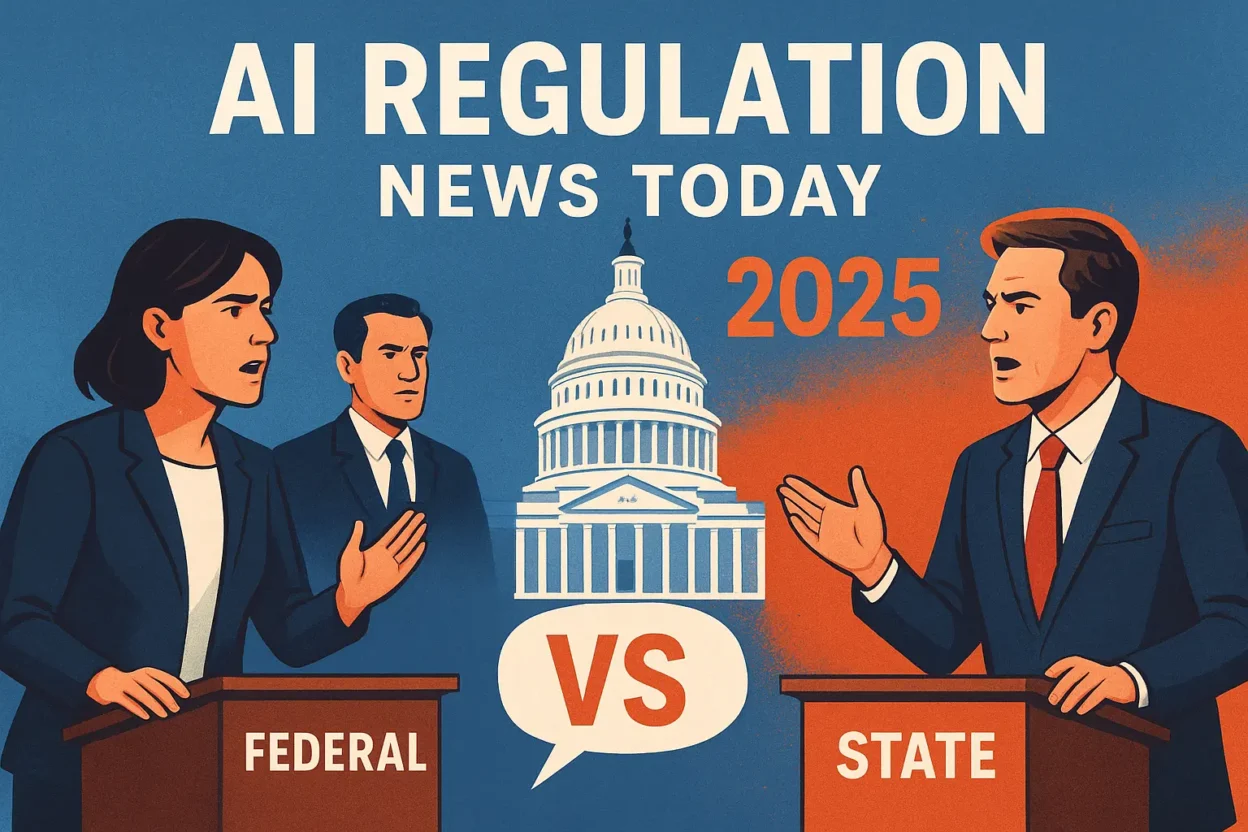
If you’ve been following AI policy even casually, you already know things have been heating up. But over the last few weeks, the conversation around “AI regulation” shifted from slow-moving and theoretical to something very real almost chaotic. And at the center of the storm isn’t the technology itself; it’s the question of who gets to regulate it.
For the first time, national lawmakers are inching closer to creating a federal AI rulebook. And in response, states many of which have already passed their own AI laws aren’t exactly thrilled about the idea of getting boxed out. So now, what was once a nerdy policy debate has turned into a full-blown political showdown.
This is the story of how today’s AI regulation landscape turned into a tug-of-war between states trying to protect consumers and federal players aiming to keep everything under one roof.
Why AI Regulation Matters Today More Than Ever
It’s no secret that AI has grown absurdly fast. And with that growth has come a mix of innovation, confusion, and legitimate risk: deepfakes that fool millions, AI scams targeting seniors, biased algorithms, and everything in between.
For years, there’s been no meaningful national framework protecting consumers. So states took matters into their own hands drafting dozens of laws that aim to limit harms, enforce transparency, or at least set some basic safety expectations.
But the federal government sees things differently they argue that letting each state write its own AI rules is messy inefficient and risky for innovation. States fire back saying that waiting for Washington to act leaves people vulnerable today. And that’s how we ended up in the race to regulate AI a race that has now triggered one of the biggest federal-state power struggles of the decade.
The Spark States Act First While Washington Waits
Over the last year, states moved Very quickly.
- More than 38 states created over 100 AI-related laws.
- Many target deepfakes, transparency, consumer protection and government use of AI.
- Some like California’s safety bill or Texas’ governance rules go even further.
These laws share a common theme don’t wait for a disaster act now.
But major tech companies plus a network of pro-AI advocacy groups argue that state-by-state regulations create a patchwork nightmare for AI developers. The pace varies wildly the definitions are inconsistent and companies claim it creates compliance chaos.
Federal lawmakers seemed to agree at least partially. This is where the fight really began.
The Federal Push National Standard or Nothing at All
Over the past month national lawmakers started floating new proposals aimed at limiting states’ ability to regulate AI altogether. Two major efforts are driving the conversation
1. The NDAA Add-On
Some House leaders quietly proposed adding AI preemption language to the National Defense Authorization Act.
Translation Sneak in a clause preventing states from passing their own AI laws. The reaction from many lawmakers not positive.
2. A Leaked Executive Order Draft
A draft federal order surfaced that would
- Challenge state AI laws in court
- Pressure agencies to override state regulations
- Create a national AI litigation task force
- Shift oversight power to officials aligned with pro-industry positions
The leak caused enough internal backlash that the order reportedly got put on hold but not before raising red flags across Congress and state governments.
The political message was clear some people in Washington want a unified AI rulebook even if it means taking authority away from the states entirely.
Why Tech Companies Support Federal Preemption
The AI industry has made its stance loud and clear one national policy is better than 50 different state laws.
Their core arguments:
- Innovation slows down when regulations differ state-to-state
- Compliance becomes expensive for startups
- The U.S. might lose its lead against global competitors
- State lawmakers often have limited technical expertise
Several major pro-AI groups funded by well-known industry figures have launched multi-million-dollar campaigns pushing for federal preemption. They believe AI innovation blossoms with fewer barriers.
But here’s the catch many of these groups support preemption without strong federal protections in place. States see this as a giant red flag.
The States Push Back Don’t Cut Us Out
State lawmakers argue that until a federal framework exists and actually functions blocking states from acting is dangerous. Their counterpoints:
- States move faster than Congress.
- Local populations face unique risks.
- Removing state authority leaves consumers vulnerable.
- Industry should not be trusted to self-regulate entirely.
Over 200 federal lawmakers co-signed letters opposing the preemption proposal. Nearly 40 state attorneys general did the same. The message was unified states should be allowed to respond to emerging risks without waiting years for national politics to settle.
A Patchwork or a Safety Net The Core Debate
Federal advocates call state regulations a patchwork. State advocates call it a safety net. Both sides have a point. Why the Patchwork Criticism Isn’t Entirely Accurate
Experts argue:
- AI companies already navigate much tougher EU rules
- Other industries operate under varying state laws all the time
- The real concern may be reduced accountability
Why State Action Still Matters
- Deepfake-related crimes happen now, not one year from now
- Fraud cases involving AI are exploding
- Emergency safety standards often start at the state level before becoming national policy
The debate boils down to one philosophical question Should we regulate AI proactively or reactively. Tech groups prefer fixing problems after they occur. States prefer preventing them before they do.
What a Federal AI Standard Might Look Like
Behind the scenes a large federal AI bill over 200 pages long is being drafted. While early, it’s expected to include
Core Components
- Anti-fraud protections
- Deepfake labeling requirements
- Child safety protections
- Whistleblower safeguards
- Transparency disclosures
- Compute resources for academic researchers
- Mandatory testing of advanced AI systems
But here’s the twist The bill does not propose direct government model audits something many safety experts have demanded. That makes it less strict than other versions floating around in the Senate.Supporters say a softer bill has a better chance of becoming law. Critics say it might not go far enough.Either way, it’s the closest the U.S. has come to a national AI standard.
AI Regulation Timeline Where Things Stand Today. Here’s the short version
| Stage | What’s Happening |
| States | Passing dozens of AI laws quickly |
| Federal Government | Trying to create a national rulebook |
| Tech Industry | Pushing for preemption to avoid 50 different laws |
| Congress & States | Strong resistance to losing regulatory authority |
| Outcome So Far | No national law yet and no agreement on who gets final say |
We are witnessing the formation of a long-term political battle that will shape how AI is developed, deployed and regulated for decades.
FAQs AI Regulation News Today
Why is there a conflict between states and the federal government on AI regulation?
Because states want to regulate AI now while the federal government wants a single national policy and both believe their approach is safer.
Are tech companies supporting federal preemption?
Yes, Many prefer one national law over navigating different rules in every state.
What risks are states trying to address with their AI laws?
Deepfakes, fraud, discrimination, data misuse, safety concerns and transparency issues.
Will a federal AI law pass soon?
Unclear. A major bill is in progress but political divisions may slow it down.
Can states continue regulating AI until a national standard is passed?
For now yes and they are moving quickly.
Conclusion: The Future of AI Regulation Is Being Written in Real Time
The fight over who regulates AI isn’t just political theater it’s a sign of how powerful and disruptive AI has become. We’re watching a foundational moment in tech governance unfold. The stakes are huge innovation, national competitiveness, consumer safety and the basic expectations we’ll place on AI systems for years ahead. Whether the U.S. ends up with a single national framework or a blended federal-state system. One thing is certain AI regulation news today is only the beginning. And the next chapter will likely be even more intense.